
OpenAI Swarm, AutoGen 0.4 & PydanticAI: Multi-Agent Architectures
A deep architectural dive into the new wave of multi-agent orchestration frameworks: dissecting OpenAI Swarm’s lightweight handoff primitives, AutoGen 0.4’s asynchronous event-driven actor runtime, PydanticAI’s type-safe schema enforcement, and smolagents code-action execution.
OpenAI Swarm · AutoGen 0.4 · PydanticAI · smolagents
The Multi-Agent Paradigm Shift: From Monolithic Chains to Specialized Swarms
The engineering consensus around autonomous LLM systems has shifted irrevocably. Heavyweight, monolithic chains that attempt to solve complex multi-step problems inside a single context window are rapidly being retired in production. In their place, engineers are standardizing on multi-agent swarms: decoupled, single-purpose agents that coordinate via explicit state handoffs, strictly enforced schemas, and deterministic communication protocols.
This week witnessed monumental releases across the open-source ecosystem that solidify this transition. From OpenAI’s minimalist exploration of agent handoffs to enterprise-grade asynchronous actor frameworks, today’s technical field note breaks down the 4 leading multi-agent runtimes dominating developer roadmaps.
1. OpenAI Swarm: Stateless Multi-Agent Coordination Primitives
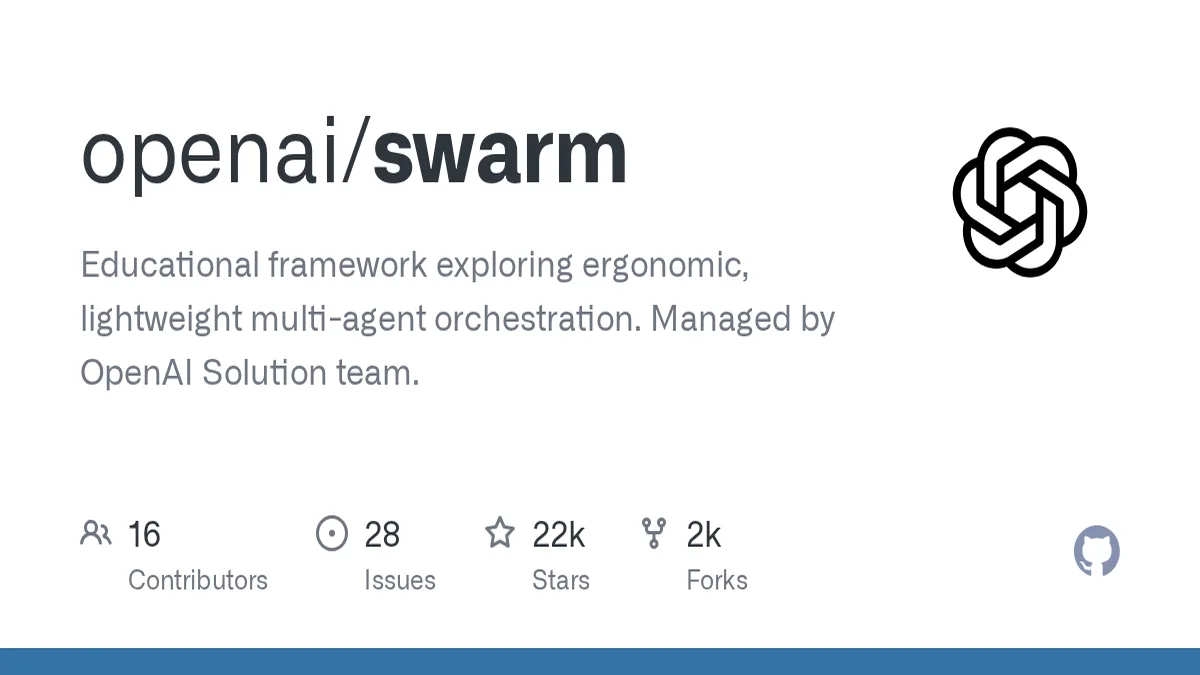
Released by OpenAI’s solutions engineering team, Swarm is an experimental, minimalist multi-agent framework designed to demonstrate that agent coordination does not require complex graph abstractions or heavyweight runtime engines:
- The Two Core Primitives (Agents & Handoffs): Swarm operates entirely on two concepts. An
Agentencapsulates instructions and a collection of executable tools. A Handoff is simply a function that returns anotherAgentinstance, signaling to the execution loop that control should be transferred immediately. - Stateless Client Loop: Unlike stateful frameworks that manage memory in background processes, Swarm is completely stateless between turns. It leverages the standard OpenAI Chat Completions API, passing the conversation history and executing tool calls locally in a clean, inspectable Python loop.
- Zero Abstraction Overhead: With less than 800 lines of core Python code, Swarm strips away boilerplate, making it the ideal architectural pattern for developers seeking complete transparency over tool execution and model context without dependency bloat.
2. AutoGen 0.4: Asynchronous, Event-Driven Actor Architecture
Microsoft’s AutoGen has undergone a ground-up rewrite in its 0.4 release, abandoning synchronous conversation loops in favor of a robust distributed actor model inspired by Erlang and Akka:
- Core Event Bus & Messaging: Agents in AutoGen 0.4 communicate via an asynchronous message-passing bus. Every agent is an independent actor that processes inbound messages, updates local state, and publishes events without blocking the global application thread.
- Cross-Language Interoperability: The new architecture features gRPC-based language-agnostic interfaces, enabling a Python-based reasoning agent to orchestrate TypeScript microservices and Go worker routines within the same swarm.
- Deterministic Human-in-the-Loop Routing: Native support for approval queues, timeout interruptions, and checkpointed state saves, ensuring that enterprise workflows can pause for managerial oversight without leaking memory or dropping inflight packets.
3. PydanticAI: Production-Grade Type-Safe Agent Harnesses
Developed by the creators of Pydantic, PydanticAI brings Python’s most trusted data validation library directly into agent development:
- Model-Agnostic Structured Outputs: Guarantees that agent responses adhere strictly to typed Pydantic models across OpenAI, Anthropic, Gemini, and local Ollama/vLLM endpoints. If a model returns invalid JSON, PydanticAI automatically reflects the validation error back to the model for inline self-correction.
- Dependency Injection & Testability: Introduces type-safe dependency injection into agent tool definitions. Database pools, API credentials, and runtime configurations are injected cleanly, enabling unit testing of complex agent behaviors without live LLM calls.
- Logfire Native Observability: Full OpenTelemetry instrumentation out of the box, streaming execution traces, token consumption metrics, and tool execution durations to observability backends with zero code configuration.
4. smolagents (Hugging Face): Code Agents That Write Their Actions
Hugging Face’s smolagents library presents a radically efficient alternative to traditional JSON tool-calling:
- Executable Code Actions: Rather than forcing models to generate nested JSON strings for tool arguments, smolagents prompts the LLM to write raw executable Python code blocks that call functions directly.
- 30% Token Overhead Reduction: Executing code actions reduces context window consumption by over 30% compared to verbose JSON payloads and eliminates multi-step serialization errors.
- Sandboxed Local Interpretation: Includes a secure, lightweight AST interpreter that executes generated Python code in memory, isolating execution from dangerous system-level calls while supporting native loops, data transformations, and variable assignments.
Multi-Agent Framework Comparison Matrix
The table below contrasts the 4 leading multi-agent frameworks across architectural pillars:
| Framework | Core Abstraction | Execution Pattern | State Management | Ideal Production Use Case |
|---|---|---|---|---|
| OpenAI Swarm | Agents & Functional Handoffs | Client-side synchronous loop | 100% Stateless (Chat Context) | Customer support triage & educational prototypes |
| AutoGen 0.4 | Asynchronous Actor Model | Event-driven pub/sub messaging | Distributed stateful actors | Enterprise microservices & multi-turn simulations |
| PydanticAI | Type-Safe Schema Validation | Model-agnostic structured calls | Injected context & dependencies | Strict API gateways & mission-critical business data |
| smolagents | Direct Code Actions | Sandboxed Python AST execution | In-memory variable space | Data analysis, computation & token-efficient tasks |
Architectural Recommendation for Production Teams
When architecting production multi-agent systems, adopt a tiered approach:
- Use Swarm patterns for triage: Frontline customer intake and initial query routing benefit from simple handoffs without state overhead.
- Enforce PydanticAI at system boundaries: When agents interact with financial ledgers, customer databases, or external APIs, enforce strict Pydantic models to eliminate parsing hallucinations.
- Deploy AutoGen 0.4 for long-running workflows: For background workflows requiring asynchronous coordination across multiple enterprise teams, leverage event-driven actors.
Verified Primary Citations & Technical Documentation
- OpenAI Solutions Engineering: Swarm Lightweight Multi-Agent Orchestration Repository (github.com/openai/swarm).
- Microsoft Research: AutoGen 0.4 Distributed Agentic Actor Architecture Whitepaper.
- Pydantic Team: PydanticAI Agent Framework & Type-Safe Output Specification (pydantic.dev).
- Hugging Face: smolagents Code-Action Framework & Local Interpreter Documentation.
Building Autonomous Multi-Agent Workflows or Enterprise Swarms?
ABATA AI architects deterministic agent systems and custom model routing pipelines for OpenAI Swarm, AutoGen & PydanticAI: Multi-Agent Orchestration Benchmark (openai-swarm-autogen-pydan). Book a 20-minute operational diagnosis with our engineering founders.