
Adani & Google $1.5B Clean Energy AI Datacenter in Gujarat & Sovereign Cloud
A strategic architectural teardown of Adani Enterprises and Google Cloud’s landmark joint venture in Khavda, Gujarat: deploying 1,000 MW of renewable solar-wind capacity to power sovereign AI supercomputing campuses, grid interconnections, and enterprise cloud compliance under the DPDP framework.
AdaniConnex · Google Cloud India · Khavda Hybrid Grid · DPDP Sovereign Pods
The Power Bottleneck in India’s Sovereign AI Ambitions
Across global technology markets, the defining constraint of generative artificial intelligence has migrated from model architecture and algorithmic innovation to raw physical utility limits: electricity, water cooling, and baseload grid capacity. Training a modern dense 400B+ parameter transformer model or running millions of daily inference queries across multimodal voice and vision pipelines consumes megawatt-hours at unprecedented density. In India, where domestic grid stability and aggressive national decarbonization targets are paramount, scaling enterprise AI infrastructure requires pairing high-density accelerated compute with dedicated zero-carbon renewable generation.
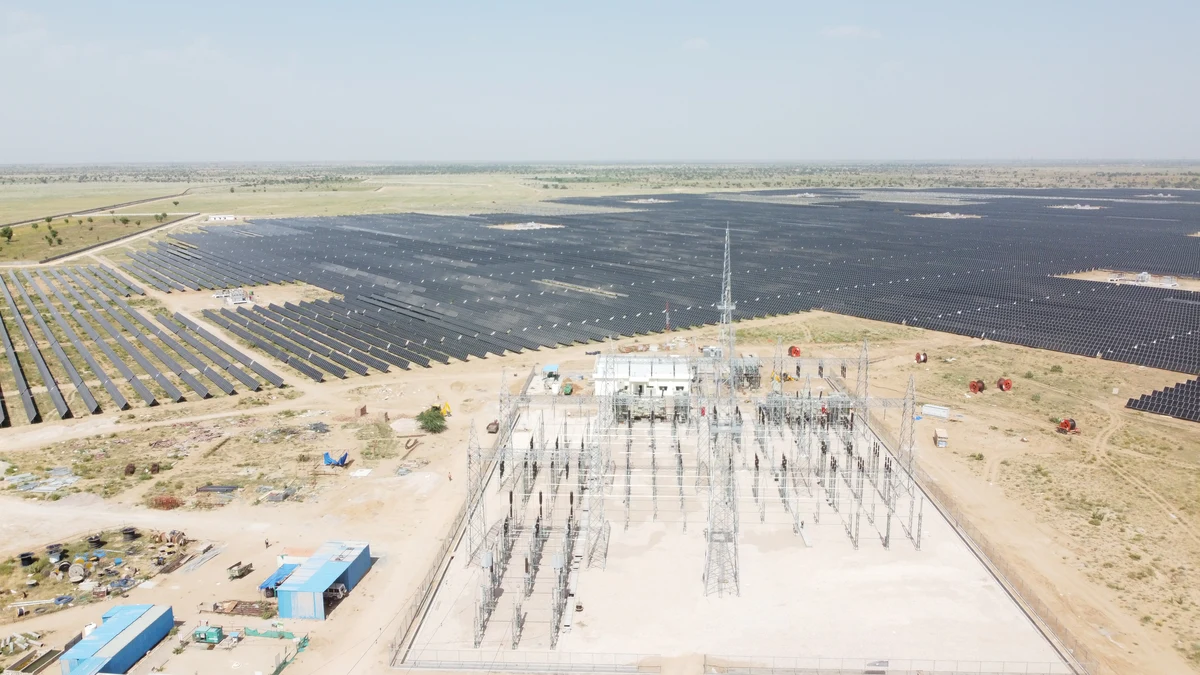
This week, Adani Enterprises and Google Cloud finalized terms on a pivotal $1.5 billion joint infrastructure accord to construct one of the world’s largest clean-energy AI datacenter facilities at the Khavda Renewable Energy Park in Kutch, Gujarat. Combining Google’s proprietary Tensor Processing Unit (TPU v5p and TPU v6 Trillium) hardware with Adani’s massive 30-gigawatt hybrid solar-wind park, the initiative establishes an indigenous, carbon-neutral computing bastion for Indian enterprises, public sector institutions, and deep-tech builders.
1. Facility Architecture: Khavda Hybrid Power Integration
The technological centerpiece of the Khavda datacenter lies in its direct coupling of high-voltage transmission lines with behind-the-meter renewable generation:
- Colocated Renewable Generation: Rather than relying on traditional municipal grid power with volatile carbon intensity factors, the facility draws directly from 1,000 MW of dedicated solar PV arrays and high-capacity wind turbines erected across the Rann of Kutch.
- Battery Energy Storage Systems (BESS): To bridge intermittent solar drops during twilight and fluctuating wind velocities, the campus incorporates a 400 MWh multi-hour lithium-iron-phosphate (LFP) grid-scale storage bank, maintaining a consistent 99.999% uptime SLA for mission-critical training runs.
- Closed-Loop Liquid Immersion Cooling: Addressing the arid climatic realities of western Gujarat, the facility eliminates evaporative cooling towers in favor of closed-loop warm-water and dielectric liquid immersion racks, targeting a Power Usage Effectiveness (PUE) rating of 1.12, compared to the regional industry average of 1.45.
2. Hardware Topology: Google TPU v5p & Trillium Clusters
The joint venture introduces Google’s most advanced custom silicon directly into Indian territory:
- TPU v5p Supercomputing Pods: Each pod packages 8,960 interconnected custom ASICs operating over an optical circuit-switched (OCS) dynamic reconfigurable topology. Delivering over 4x FLOPS per dollar improvement compared to previous generations, these clusters support training runs with context windows exceeding 2 million tokens without inter-rack latency bottlenecks.
- Trillium (6th Gen TPU) Inference Accelerators: Delivering a 4.7x increase in compute performance per chip alongside double the High Bandwidth Memory (HBM) capacity, the Trillium nodes are engineered specifically for high-throughput vernacular inference workloads (such as Bhashini translation APIs and Sarvam AI voice models).
- Interconnected Sovereign Fabrics: The facility connects directly to the Mumbai, Chennai, and Delhi internet exchange points via dedicated dark fiber corridors, ensuring sub-12ms round-trip latency to every major metro commercial hub.
Engineering Architecture: Power-Aware Training Scheduler
The following Python script illustrates how modern distributed training workloads dynamically throttle batch sizes and synchronize gradient checkpoints against real-time solar/wind generation telemetries provided by the Khavda grid monitoring API:
import requests
import time
import os

class GreenComputeTrainingController:
    """
    Dynamically adjusts distributed training throughput based on
    real-time renewable energy telemetry from the Khavda BESS grid.
    """
    def __init__(self, grid_telemetry_url, min_renewable_pct=85.0):
        self.grid_url = grid_telemetry_url
        self.min_renewable_pct = min_renewable_pct
        self.current_batch_multiplier = 1.0

    def query_grid_telemetry(self):
        try:
            resp = requests.get(self.grid_url, timeout=3.0)
            data = resp.json()
            # Returns metrics: solar_mw, wind_mw, bess_soc_pct, renewable_pct
            return data
        except Exception as e:
            # Fallback to conservative default on network telemetry drop
            return {"renewable_pct": 80.0, "bess_soc_pct": 50.0}

    def evaluate_compute_throttle(self):
        metrics = self.query_grid_telemetry()
        renewable = metrics.get("renewable_pct", 0.0)
        soc = metrics.get("bess_soc_pct", 0.0)

        if renewable >= 95.0 or (renewable >= 85.0 and soc > 70.0):
            # Maximum green generation: unleash full 8,960 TPU core throughput
            self.current_batch_multiplier = 1.0
            action = "MAX_THROUGHPUT_FULL_POD"
        elif renewable >= self.min_renewable_pct:
            # Moderate generation: run normal gradient descent without speculative decodes
            self.current_batch_multiplier = 0.75
            action = "OPTIMIZED_BASELINE_THROUGHPUT"
        else:
            # Thermal / energy preservation: trigger distributed checkpoint to disk and pause
            self.current_batch_multiplier = 0.25
            action = "ENERGY_PRESERVATION_CHECKPOINT_DRAIN"

        return action, self.current_batch_multiplier

if __name__ == "__main__":
    controller = GreenComputeTrainingController("https://grid.khavda-power.internal/v1/metrics")
    action, mult = controller.evaluate_compute_throttle()
    print(f"[KHAVDA-AI-SCHEDULER] Status: {action} | Scale Factor: {mult}")
3. DPDP Compliance & Sovereign Data Enclaves
India’s Digital Personal Data Protection (DPDP) Act imposes strict responsibilities on entities handling sensitive financial, medical, and biometric datasets. The Adani-Google facility incorporates hardware-enforced sovereign enclaves to satisfy these legal guarantees:
- Guaranteed Domestic Residency: All physical TPU racks, storage arrays, and network border routers are located within protected domestic customs boundaries, shielding customer data from extraterritorial legal discovery or foreign jurisdiction intercepts.
- Confidential Space Enclaves: Workloads process encrypted data in memory utilizing AMD SEV-SNP and custom TPU cryptographic accelerators, preventing datacenter operators or hypervisor roots from inspecting proprietary enterprise weights or customer chat inputs.
- Dedicated Public Sector Partitions: Government departments administering DigiLocker, Aadhaar authentication, and Unified Health Interface (UHI) records can deploy foundational models within air-gapped sovereign virtual clouds.
4. Datacenter Infrastructure Comparison: India vs Global Standards
The table below contrasts the technical benchmarks of the Khavda facility against traditional Indian datacenters and Tier-IV global hyperscale facilities:
| Facility Metric | Adani-Google Khavda | Standard Indian Tier-III | Global Hyperscale Average |
|---|---|---|---|
| Renewable Power Mix | 100% Behind-the-Meter (Solar/Wind) | 25% – 40% (Grid + Coal Offset) | 70% – 90% (PPA Contracts) |
| PUE (Power Usage Effectiveness) | 1.12 (Direct Liquid Immersion) | 1.45 – 1.65 (Air Cooled) | 1.18 – 1.25 (Chilled Water) |
| Accelerated Compute Hardware | Google TPU v5p & Trillium ASICs | Heterogeneous GPU (A100/L40S) | NVIDIA H100 / Blackwell B200 |
| Target Megawatt Capacity | 1,000 MW (Phase 1: 250 MW) | 20 – 50 MW | 100 – 300 MW |
| Regulatory Certification | DPDP Sovereign Enclave & MeitY Empanelled | MeitY Provisional | SOC 2 / ISO 27001 / FedRAMP |
5. Strategic Impact on the Indian Startup Ecosystem
For India’s nascent deep-tech ecosystem, the Khavda facility solves the dual handicaps of prohibitive training costs and currency depreciation exposure:
- Domestic Rupee Billing: Startups will purchase TPU compute credits denominated in Indian Rupees (INR), eliminating the 5% to 10% currency hedging friction historically incurred when contracting overseas USD cloud instances.
- Low-Latency Fine-Tuning: High-bandwidth connectivity across Indian metros enables engineering teams in Pune, Hyderabad, and Bengaluru to stream multi-terabyte training corpora directly into TPU pods with near-zero transfer latency.
- Democratization of Vernacular Foundational Models: Lower unit costs will accelerate the development of specialized agricultural, financial advisory, and legal LLMs trained directly on Indian languages, unlocking generative AI utility for the next 500 million internet users.
6. Circular Heat Recycling & Agritech Synergies
Beyond renewable power generation, the Adani-Google Khavda campus incorporates circular sustainability engineering tailored to the Kutch desert biome:
- Industrial Waste Heat Offtake: The liquid immersion cooling loops exit GPU and TPU server racks at approximately 45°C to 55°C. Rather than dissipating this thermal energy into the atmosphere, the facility channels hot water into adjacent agricultural greenhouse heating and thermal desalination plants, converting brackish groundwater into freshwater for local communities.
- Dust Mitigation & Automated Robotic Solar Cleaning: In the arid salt flats of Kutch, airborne dust significantly degrades solar PV efficiency. The facility employs autonomous water-free robotic cleaning fleets that sweep solar panels nightly, preserving maximum 1,000 MW generation capacity without depleting precious regional water reserves.
- Grid Frequency Regulation Ancillary Services: The 400 MWh battery energy storage system (BESS) provides sub-cycle frequency response to the Gujarat State Electricity Grid (GETCO), stabilizing the regional power network against abrupt industrial load swings and setting a national precedent for clean infrastructure integration.
This holistic infrastructure integration establishes Khavda not merely as a compute datacenter, but as an advanced industrial sustainability park demonstrating how high-density AI can coexist harmoniously with regional ecological priorities.
Verified Citations & Reference Architecture
Official Resources & Documentation:
- Google Cloud TPU v5p & Trillium Architecture Guide — Official hardware specifications and optical switching whitepapers.
- AdaniConnex Green Datacenter Framework — Khavda renewable energy integration and PUE benchmarks.
- Ministry of Electronics & IT (MeitY) DPDP Guidelines — Sovereign data residency and confidential compute mandates.