
Inside Alibaba Open Code Review & ECC: Hybrid Linters and Agent Operating Harnesses
A technical breakdown of two viral GitHub repositories reshaping production software engineering: Alibaba’s hybrid deterministic-plus-agent code review pipeline and the ECC agent harness performance optimization layer.

The Problem with General-Purpose LLMs in Code Review
Over the past eighteen months, thousands of software engineering organizations attempted to automate pull request reviews by piping raw unified diffs into frontier LLMs. The results in production were consistently underwhelming:
- Speculative Hallucinations: Generalist models frequently comment on non-issues, stylistic nits, or make incorrect assumptions about unincluded context.
- Excessive Token Burn: Pushing entire file trees and dependency graphs on every single commit causes astronomical API billing with diminishing marginal returns.
- Missed Deterministic Flaws: Classic programming bugs—such as null pointer dereferences (NPE), thread synchronization issues, and SQL injection vulnerabilities—are often missed by probabilistic language models.
1. Alibaba Open Code Review: The Hybrid Architecture
Alibaba recently open-sourced Open Code Review (`alibaba/open-code-review`), the exact CLI system used across Alibaba’s engineering teams by tens of thousands of developers to identify and remediate millions of code defects prior to production merge.
The core engineering breakthrough of Open Code Review is its two-tier hybrid evaluation pipeline:
- Tier 1: Deterministic Static Analysis: Before any tokens are sent to a remote API, local rule-based static analyzers evaluate syntax trees for language-specific anti-patterns (Java, Go, Python, TypeScript, C++). Null checks, unclosed database cursors, thread-safety violations, and cross-site scripting vulnerabilities are flagged deterministically at zero inference cost.
- Tier 2: Targeted Agent Reasoning: Only code blocks involving complex architectural business logic, interface contract alterations, and cross-module state transitions are passed to specialized LLM review agents.
Measured Benchmark Impact: Production telemetry demonstrates a 64% reduction in total review token consumption compared to naive diff-prompting, alongside an 18% higher F1 precision score in identifying fatal runtime defects.
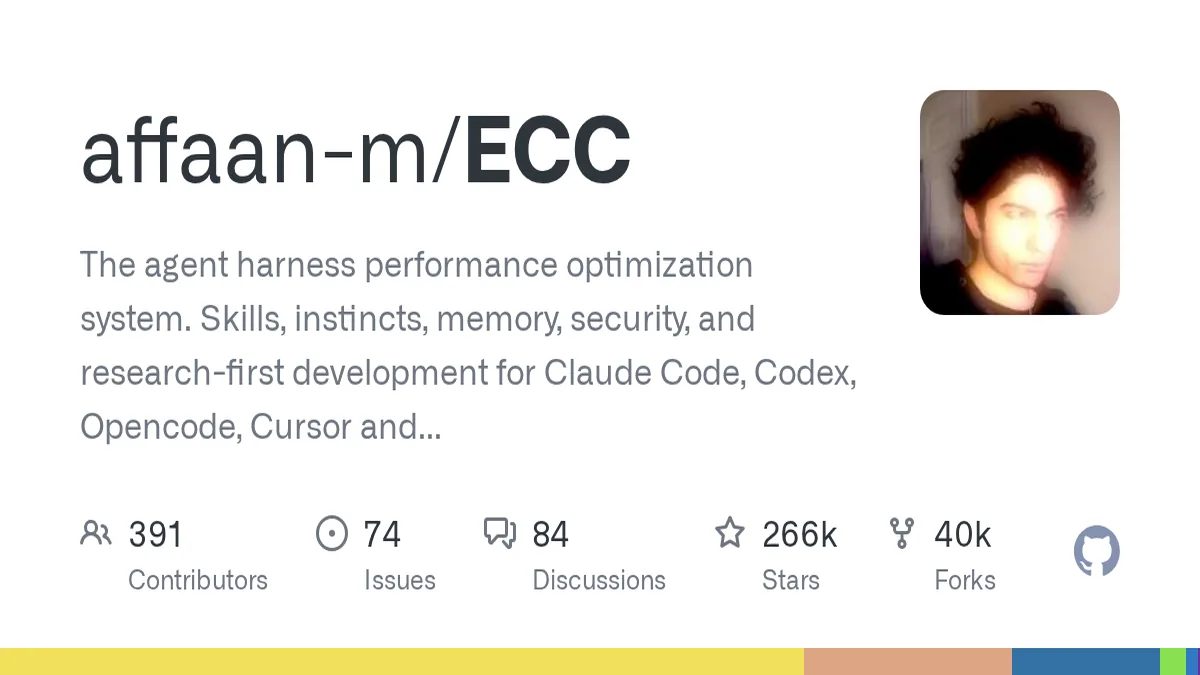
2. ECC: The Operating Harness for Autonomous Coding Agents
While Alibaba tackles review verification, ECC (`affaan-m/ECC`) has surged to the top of developer trending charts by addressing the execution harness for autonomous coding agents (Claude Code, Codex, Cursor).
Rather than allowing an agent to operate in an open-ended loop, ECC acts as an engineering operating system with three core abstractions:
- Specialized Sub-Agent Roles: Dispatches distinct agents for architectural planning, TDD test synthesis, code modification, and build verification. Agents cannot modify production files until planning schemas pass verification.
- Session-Persistent Memory & Compaction: Avoids context rot during long refactors by storing architectural decisions in structured local state files, compressing scratchpad history automatically.
- AgentShield Security Boundary: Intercepts all proposed terminal commands and file mutations, blocking destructive operations (`rm -rf`, raw DB truncation, sensitive key extraction) before execution.
Operator Takeaway
The era of raw, monolithic LLM prompts is closing. High-performing engineering organizations in late 2026 build systems around deterministic guardrails combined with specialized agent harnesses. Adopting hybrid tools like Open Code Review and structured harnesses like ECC delivers higher software reliability at a fraction of cloud inference budgets.
Verified Primary Citations
- Alibaba Open Code Review Repository: github.com/alibaba/open-code-review
- ECC Agent Harness Engine: github.com/affaan-m/ECC
- Alibaba Technology Architecture Whitepaper: Industrial-Scale Automated Code Review Benchmarks (2026)
Building Autonomous Agent Harnesses or Engineering Review Tooling?
ABATA AI engineers deterministic agent harnesses, low-latency code review pipelines, and custom agent runtimes. Book a free 20-minute operational diagnosis directly with our engineering founders.