
Daily AI News: Nuclear Energy Giants Partner with Big Tech for 5GW Frontier Datacenter Grids
An investigative energy and technology report: dissecting multi-billion dollar power purchase agreements between nuclear operators (Constellation, Westinghouse) and hyperscale cloud providers (Microsoft, Amazon, Google) to build dedicated 5GW clean grids for next-generation frontier AI clusters.
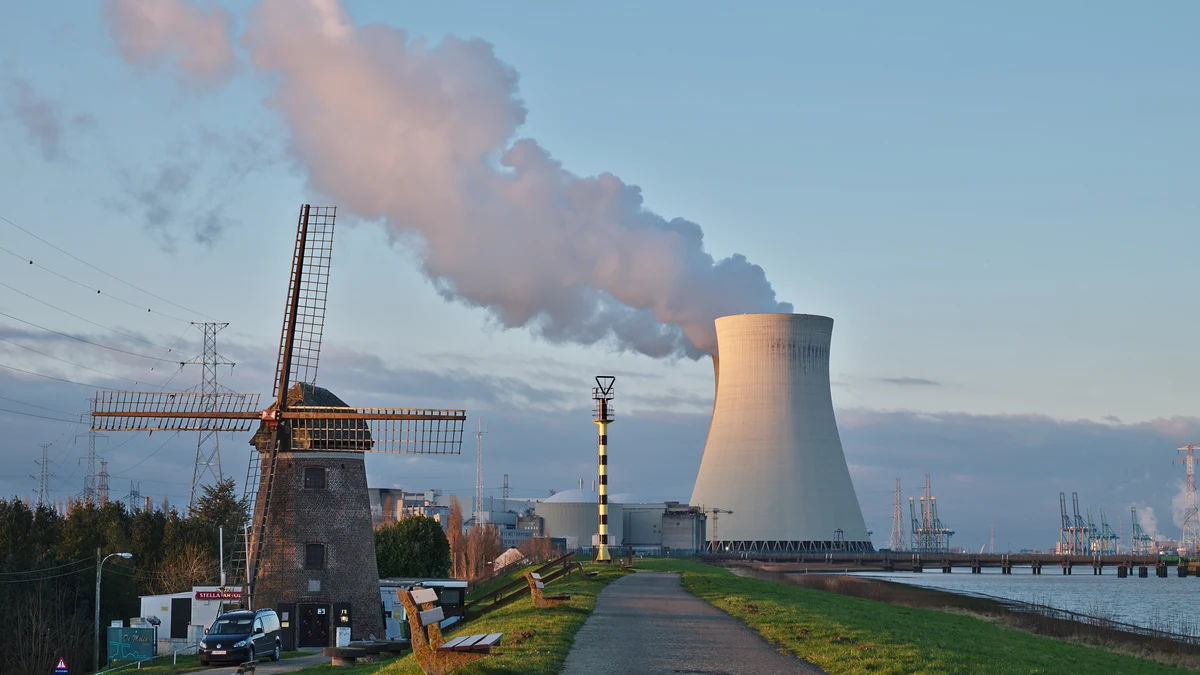
Photo: Wikimedia Commons / Creative Commons
The Energy Reckoning in Frontier Artificial Intelligence
For the past three years, the limiting factor in artificial intelligence scaling was commonly perceived to be silicon availability: securing sufficient allocations of NVIDIA H100, B200, or bespoke ASIC accelerators from TSMC foundries.
In the final quarter of 2026, the primary bottleneck has shifted from silicon to electrons.
Training and operating the next generation of frontier foundation models—systems operating with over 10^27 FLOPs and serving hundreds of millions of autonomous agent tasks daily—requires unprecedented quantities of continuous, zero-carbon baseload electricity. A modern 100,000-GPU cluster consumes roughly 150 to 250 megawatts (MW) of continuous power. Next-generation multi-million-GPU campuses planned for 2027 and 2028 require 1 to 5 gigawatts (GW)—the equivalent electrical output of a major metropolitan city.
Traditional municipal electrical grids cannot supply this load without destabilizing local residential power networks. In response, the world’s largest hyperscale technology giants (Microsoft, Amazon Web Services, Google, and Oracle) have initiated the largest private clean energy mobilization in industrial history: signing historic, multi-decade Power Purchase Agreements (PPAs) to re-commission decommissioned nuclear reactors and deploy fleets of Small Modular Reactors (SMRs) co-located directly with AI datacenter campuses.
The Nuclear Renaissance: Key Landmark Transactions
The convergence between hyperscale tech and nuclear utilities has accelerated dramatically in early October 2026, highlighted by three transformative transactions:
1. The Three Mile Island Re-Commissioning (Crane Clean Energy Center)
Under a historic 20-year agreement with utility giant Constellation Energy, Microsoft has contracted 100% of the generating capacity of the restored Unit 1 reactor at Pennsylvania’s Three Mile Island. Renamed the Crane Clean Energy Center, the facility will inject over 835 megawatts of 24/7 carbon-free power directly into the PJM regional grid to power Microsoft’s regional AI datacenter footprint.
2. Amazon Web Services & Talen Energy: Co-Located Nuclear Compute
AWS completed its acquisition of the Cumulus Data Campus directly adjacent to the 2.5-gigawatt Susquehanna nuclear power station in Pennsylvania. By connecting server racks directly behind the reactor’s transmission substation (bypassing public utility transmission tariffs), AWS eliminated transmission line congestion and secured dedicated baseload power scalable up to 960 megawatts.
3. Google & Kairos Power: Commercializing Small Modular Reactors (SMRs)
Pioneering the next wave of nuclear technology, Google signed a groundbreaking corporate agreement with Kairos Power to deploy a fleet of advanced Small Modular Reactors utilizing molten salt cooling technology. The agreement targets 500 megawatts of commercial SMR power by 2030, delivering modular, localized clean electricity capable of scaling incrementally with datacenter compute expansions.
Comparative Economics: Energy Sources for Hyperscale AI Datacenters
| Power Generation Modality | Capacity Factor (Baseload Reliability) | Carbon Footprint (Lifecycle) | Levelized Cost of Electricity (LCOE) | Datacenter Suitability |
|---|---|---|---|---|
| Commercial Nuclear (Light Water / SMR) | 92% – 95% (Continuous 24/7) | Near-Zero (<12 gCO2eq/kWh) | $65 – $95 / MWh | OPTIMAL: Matches continuous GPU baseload perfectly |
| Solar Photovoltaic + BESS Battery | 24% – 32% (Intermittent) | Zero operational | $85 – $140 / MWh (with 8hr storage) | Insufficient for 24/7 training runs without grid backup |
| Natural Gas Combined Cycle (NGCC) | 85% – 90% (Reliable) | High (~420 gCO2eq/kWh) | $45 – $65 / MWh | Reliable interim stopgap; violates corporate net-zero pledges |
The Federal Push: The White House Datacenter Energy Directive
This nuclear acceleration is reinforced by federal policy. In the wake of the White House Accord on Super Intelligence signed on September 29, 2026, President Trump issued an executive directive instructing the Department of Energy (DOE) and the Nuclear Regulatory Commission (NRC) to fast-track regulatory licensing for advanced reactors:
- Accelerated NEPA Environmental Reviews: Review periods for co-located nuclear micro-reactors on industrial brownfield sites have been compressed from four years to 18 months.
- National Defense Energy Priority: AI training facilities exceeding 500 megawatts can now petition for federal critical infrastructure status, granting priority access to federal grid interconnection queues.
The Physics and Engineering of Datacenter SMR Co-Location
Why are tech giants choosing Small Modular Reactors (SMRs) over traditional large-scale gigawatt light-water reactors? The answer lies in the physics of datacenter scaling:
- Modular Incremental Sizing: Traditional nuclear plants require 10 to 15 years to construct and produce 1,200MW in a single massive block. In contrast, SMR designs (such as Kairos Power, NuScale, or X-energy) generate 50MW to 150MW per factory-fabricated module. Datacenter campuses can install two modules today to power an initial 100MW cluster, and plug in additional modules as server capacity expands.
- Passive Safety Systems: Advanced SMRs utilize passive gravity-driven cooling and molten salt or high-temperature gas coolants, eliminating the risk of catastrophic core meltdowns even in the event of complete electrical blackout.
- Direct Behind-the-Meter Interconnection: By placing SMRs on the same private industrial campus as the datacenter, operators avoid the 5-to-8 year queue required to connect new power plants to the public high-voltage transmission grid, bringing new frontier compute clusters online years ahead of competitors.
The Geopolitical Race for Clean Baseload Supremacy
The convergence of artificial intelligence and nuclear power is fundamentally altering global energy geopolitics. Nations that can rapidly build, license, and deploy clean nuclear baseload energy will become the primary hosts of the 21st-century cognitive economy.
While European nations grapple with complex grid permitting and phased nuclear shutdowns, the United States and strategic partners like India are aggressively clearing regulatory hurdles:
- In the US, the bipartisan ADVANCE Act and White House directives have streamlined reactor licensing, unlocking billions in venture capital for advanced nuclear startups.
- In India, the expansion of nuclear capacity alongside massive hybrid solar-wind parks in Gujarat and Rajasthan is laying the foundation for sovereign, gigawatt-scale AI infrastructure that can power domestic enterprise agents without reliance on fossil fuels.
For global technology directors and cloud infrastructure planners, the directive is unequivocal: access to clean, uninterrupted, gigawatt-scale electrical power has become the single most decisive metric governing artificial intelligence competitiveness. The winners of the frontier AI race will not simply be the organizations with the smartest algorithms; they will be the enterprises that secure the electrons required to bring superintelligence to life.
Strategic Implications for the Global Cloud Landscape
Executive Industry Analysis
- Compute Real Estate Follows Power Sub-Stations: The geographic footprint of AI datacenters is shifting away from traditional fiber corridors (like Northern Virginia) toward nuclear generation sites in Pennsylvania, Ohio, and Illinois, where gigawatts of power can be secured.
- Long-Term Inference Deflation: By locking in fixed-price 20-year nuclear power purchase agreements ($65-$80/MWh), hyperscalers insulate themselves from volatile fossil fuel markets, driving down the long-term cost of continuous model inference.
- Global South Replicability: India is replicating this model via the Adani-Google green energy partnership in Khavda, Gujarat, pairing 30 gigawatts of hybrid solar-wind generation with sovereign datacenter corridors to ensure clean compute independence.
Primary Citations & Technical References
- Constellation Energy Corporation. (2026). Constellation Announces Historic 20-Year Power Purchase Agreement with Microsoft for the Crane Clean Energy Center. Press Release & SEC Filing.
- Kairos Power & Google Cloud. (2026). Master Plant Development Agreement: Deploying 500MW of Small Modular Reactor Technology for Sustainable Cloud Infrastructure. Strategic Energy Briefing.
- U.S. Department of Energy (DOE). (2026). Pathways to Commercial Liftoff: Advanced Nuclear Energy and High-Density Datacenter Integration. Office of Clean Energy Demonstrations.
- Electric Power Research Institute (EPRI). (2026). AI Datacenter Power Demand and Grid Stability: 2026-2035 Infrastructure Forecast. Technical Report.