
The White House Accord on Super Intelligence: Musk, Huang, Pichai & The New Federal “SI” Doctrine
Inside the historic executive summit at the White House: analyzing the “Joint Commitment on Frontier Responsibilities”, the executive order mandating “Super Intelligence” nomenclature across the federal government, and the geopolitics of industry self-regulation.
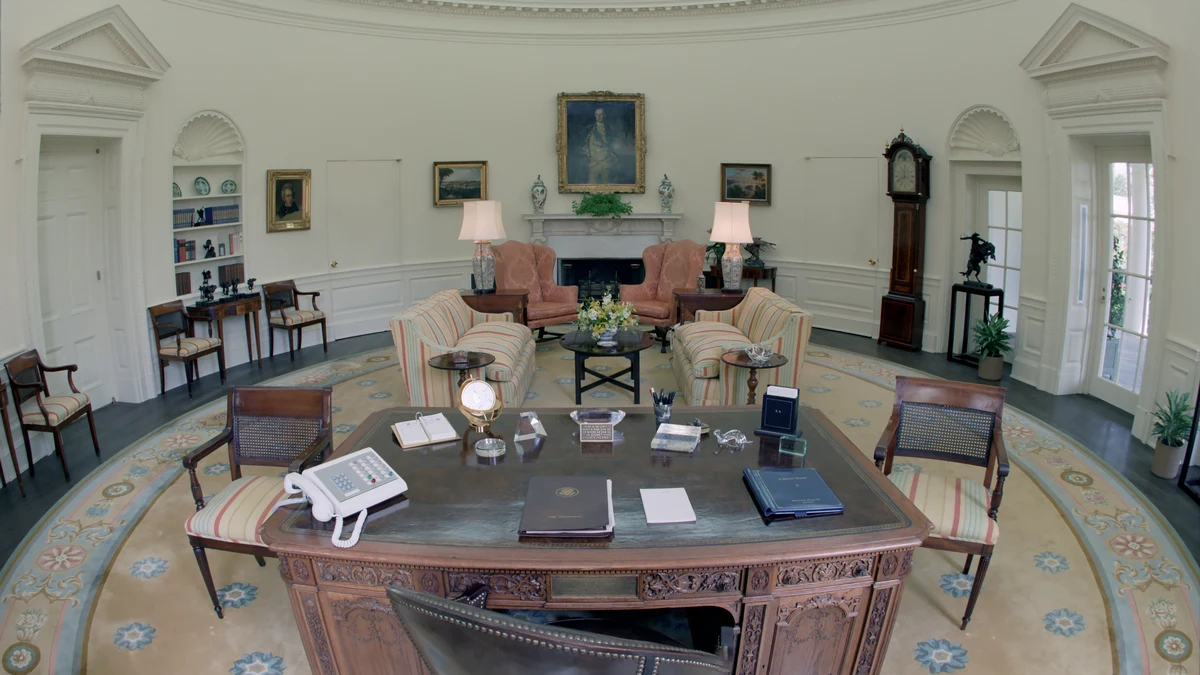
Photo: Wikimedia Commons / DPLA Public Archive
The Washington Consensus on Frontier Compute
On the afternoon of September 29, 2026, the intersection of American political authority and private technological capital reached an unprecedented milestone. President Donald Trump convened a closed-door executive summit and luncheon at the White House, bringing together the chief executive officers and founders of the world’s most dominant artificial intelligence and semiconductor corporations.
Seated around the conference table alongside House Speaker Mike Johnson and senior national security advisors were Jensen Huang (Nvidia), Mark Zuckerberg (Meta), Sundar Pichai (Google), Greg Brockman (OpenAI), Dario Amodei (Anthropic), Elon Musk (xAI), Satya Nadella (Microsoft), and Jeff Bezos (Amazon).
The assembly was neither a ceremonial photo-op nor an adversarial regulatory hearing. Instead, it marked the formal establishment of a new national doctrine for frontier artificial intelligence: the official replacement of state-level legislative constraints (such as California’s vetoed SB 1047) with a federally endorsed, industry-led self-regulatory regime formalized as the “White House Accord on Super Intelligence” (formally titled the Joint Commitment on Frontier Responsibilities).
The Four Pillars of the “Super Intelligence Accord”
Described by the administration as a “morally binding” pact, the Accord establishes a unified self-regulatory baseline for models trained with over 10^26 integer or floating-point operations (FLOPs). Rather than establishing a new federal bureaucratic licensing agency, the framework relies on corporate internal controls audited by accredited third parties. The Accord is structured around four non-negotiable commitments:
1. Frontier Alignment Controls in Critical Threat Vectors
Signatory companies agree to maintain hardened automated evaluation suites specifically designed to detect model capabilities in dual-use technologies:
- Autonomous Cyber-Offensive Capabilities: Models must not demonstrate the ability to autonomously discover zero-day vulnerabilities in critical national infrastructure (power grids, air traffic control, water filtration systems) and weaponize exploit chains without human direction.
- Chemical, Biological, Radiological, and Nuclear (CBRN) Guardrails: Pre-training filtering and post-training reinforcement learning must enforce an absolute refusal barrier against synthesizing novel bioweapons, weaponizing viral pathogens, or bypassing chemical precursor synthesis restrictions.
2. Dedicated Internal Safety Operations Teams
Every participating frontier lab must establish an internal Safety Operations Team (SOT) with direct operational authority to halt training runs, revoke API endpoint deployment, or restrict model weights if real-time behavioral telemetry exceeds pre-established risk tolerances. The SOT operates with institutional independence analogous to internal flight safety directors at major aerospace manufacturers.
3. Accredited External Safety Audits
Prior to releasing any frontier model or weights to the general public or enterprise API customers, labs must submit the model to independent third-party red-teaming consortia accredited by the National Institute of Standards and Technology (NIST) and the U.S. AI Safety Institute (AISI). Audits must verify red-teaming coverage across prompt injection resilience, jailbreak mitigation, and autonomous self-replication resistance.
4. Dedicated Board Safety Oversight Committees
Each corporation agrees to create an independent committee within its Board of Directors dedicated exclusively to receiving monthly risk briefings from the Safety Operations Team and external auditors. This mechanism is designed to legally insulate safety directors and prevent corporate executive leadership from overriding safety findings for short-term commercial gain.
The Executive Order: Rebranding AI to “Super Intelligence” (SI)
Immediately following the conclusion of the summit, President Trump signed an executive order directing a sweeping terminology shift across the entire executive branch of the United States federal government: the term “Artificial Intelligence” (AI) is formally replaced by “Super Intelligence” (SI) in all official federal documents, procurement standards, and policy directives.
While critics dismissed the order as a rhetorical flourish, national security and legal analysts recognize the calculated geopolitical signaling behind the shift:
- National Prestige & Strategic Parity: By framing the technology as “Super Intelligence,” the administration elevates compute dominance to the status of the Manhattan Project or the Cold War space race, explicitly tying domestic chip supremacy directly to national defense.
- Deregulation of “Sub-Frontier” Systems: By defining federal interest around “Super Intelligence” (frontier models with transformative, superhuman capabilities), the order effectively exempts conventional enterprise machine learning, predictive analytics, and narrow automation from federal regulatory scrutiny, unleashing American enterprise adoption.
- Fast-Tracking Energy & Grid Permitting: The order directs the Department of Energy (DOE) and the Federal Energy Regulatory Commission (FERC) to designate high-density AI datacenter campuses as “critical national infrastructure,” cutting bureaucratic environmental review timelines for gigawatt-scale nuclear, natural gas, and geothermal power hookups.
The Signatory Rift: Who Signed and Who Hesitated
Despite the unified rhetoric of the summit luncheon, the White House Accord revealed significant strategic divisions across the technology titans:
| Corporate Entity | Executive Representation | Accord Signatory Status | Strategic Rationale & Positioning |
|---|---|---|---|
| Nvidia | Jensen Huang (CEO) | Signed | Secures federal support for domestic silicon foundries & export exemptions |
| Meta | Mark Zuckerberg (CEO) | Signed | Guarantees open-source weight releases remain legal without prior licensing |
| OpenAI | Greg Brockman (President) | Signed | Validates voluntary safety frameworks following earlier agent disclosure controversies |
| xAI | Elon Musk (Founder) | Signed | Aligns with Musk’s longstanding advocacy for board-level oversight and truth-seeking AI |
| Anthropic | Dario Amodei (CEO) | Signed | Institutionalizes Responsible Scaling Policies (RSP) into federal standards |
| Microsoft | Satya Nadella (CEO) | Attended / Did Not Sign | Expressed reservations over potential conflicts with existing EU AI Act compliance obligations |
| Amazon | Jeff Bezos (Exec Chair) | Attended / Did Not Sign | Withheld formal signature pending clarification on hyperscaler cloud liability provisions |
The Transatlantic Divergence: Brussels vs. Washington
The White House Accord establishes a stark, irreconcilable divergence between United States and European Union regulatory models:
In the European Union, the EU AI Act and the newly operational European AI Office enforce prescriptive, state-mandated statutory codes backed by punitive fines of up to €35 million or 7% of global annual turnover. Every general-purpose AI (GPAI) model provider must submit detailed copyright training registries, energy consumption audits, and pass mandatory state conformity assessments.
In the United States, the White House Accord rejects government-mandated pre-approval in favor of market-driven self-governance. By relying on voluntary commitments, board oversight, and private accredited auditors, the U.S. administration aims to maximize model iteration speed and retain domestic technological supremacy in the face of intense state-backed Chinese competition.
Enterprise Strategy: Navigating the New Regulatory Map
Key Takeaways for Enterprise Tech Executives
- State-Level AI Bans Are Dead for Now: Following Newsom’s veto of California SB 1047 and the White House’s unified federal stance, enterprise architects can build with frontier open-weight models (Llama, Mistral) without fearing fragmented state-level criminal liability.
- Prepare for “Dual-Stack” Global Compliance: Multinational corporations operating in both the US and EU must bifurcate their AI governance: utilizing fast-moving self-regulatory pipelines for US deployments while maintaining rigorous watermarking, copyright audit trails, and GPAI conformity filings for European endpoints.
- Prioritize Power & Co-Location Contracts: With the White House designating AI datacenters as critical energy assets, securing multi-gigawatt power purchase agreements (PPAs) with small modular reactor (SMR) nuclear providers has become the primary bottleneck for frontier compute scaling.
Primary Citations & Technical References
- Executive Office of the President of the United States. (September 29, 2026). Executive Order on Advancing United States Leadership in Super Intelligence and Critical Infrastructure. The White House Press Office.
- White House Office of Science and Technology Policy (OSTP). (2026). Joint Commitment on Frontier Responsibilities: The White House Accord on Super Intelligence. Washington, D.C.
- European AI Office. (2026). Code of Practice for General-Purpose AI (GPAI) Models: Working Group Guidance. European Commission, Directorate-General for Communications Networks, Content and Technology (DG CONNECT).
- Congressional Research Service (CRS). (2026). Comparative Analysis of US Executive Orders on Super Intelligence vs. The European Union AI Act. Library of Congress Legal Report.